

 When your project calls for curved structural angles, precision matters. Poorly formed angles lead to fitment issues, wasted material, and costly rework that can derail production timelines. At Tube-Tec Bending, our angle bending services eliminate those risks with controlled, repeatable forming that delivers tight tolerances and consistent results across every piece in your order.
For over two decades, our Houston-based facility has served OEM, manufacturing, and industrial clients who need structural angles curved to exact specifications. Whether your application requires a single prototype or a high-volume production run, our team combines hands-on expertise with advanced equipment to produce angle bends that meet the most demanding performance and dimensional requirements.
Leg In and Leg Out Angle Bending
| Angles | |
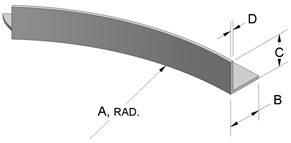 |
Leg out |
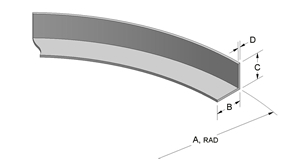 |
Leg in |
The orientation of a bent angle is critical to how it performs in your assembly. Tube-Tec Bending provides both leg in and leg out angle bending to accommodate the full range of structural and functional requirements our clients bring to us.
Leg out angle bending curves the angle so that the legs face outward from the radius of the bend. This orientation is commonly specified for applications such as flanges, tank rings, and circular supports where the outer surface of the angle needs to interface with adjacent components. Leg out bending is often the preferred method when the angle will serve as an exterior frame or structural ring.
Leg in angle bending curves the angle so that the legs face inward toward the center of the radius. This configuration is frequently used in fan housings, ductwork, interior supports, and applications where fasteners or mounting hardware need to attach along the inside of the curved profile. Leg in bending is also well-suited for rings and frames that will receive panels, sheeting, or other inset components.
Our FACCIN angle roll system and SweBend system gives us the flexibility to produce both leg in and leg out orientations with precision, and our fabrication specialists work directly with your engineering team to confirm the correct orientation before production begins.
Our Angle Rolling Process
Angle rolling is a cold-forming process that passes a structural angle through a series of rollers to progressively shape it to the desired radius. Unlike hot bending or press braking, cold rolling preserves the material's mechanical properties while producing smooth, consistent curves without localized stress points.
Tube-Tec Bending's angle rolling services are powered by our FACCIN and SweBend system, are two of the most capable machines of its kind in the industry. This equipment enables us to form angles into full rings, partial arcs, helical coils, off-axis curves, and compound bends with a high degree of repeatability.
Our 4-step process takes every project from concept through delivery:
- Consultation — We review your drawings, specifications, and application requirements to determine the optimal forming approach.
- Design Assistance — Our fabrication specialists collaborate with your team to refine dimensions, material selection, and orientation (leg in or leg out) before production.
- Prototyping — For complex or first-run projects, we produce prototype pieces for your approval so you can verify fit and function before committing to a full order.
- Manufacturing & Delivery — Once specifications are confirmed, we execute your production run with quality control checks at every stage and deliver on your timeline.
This process allows us to meet even the most complex requirements with efficiency, professionalism, and adaptability. Learn more about our complete process here.
Rolled Angle Bending Materials
The right material selection is just as important as the forming method. Tube-Tec Bending provides rolled angle bending services across a broad range of metals and alloys to match the mechanical, thermal, and corrosion-resistance requirements of your application.
- Carbon Steel — The most widely specified material for structural angle bending. Carbon steel offers an excellent balance of strength, formability, and cost-effectiveness for general industrial use. We work with multiple grades, including A36 and A50.
- Stainless Steel — Ideal for applications requiring corrosion resistance, high-temperature performance, or sanitary compliance. Our team has extensive experience forming stainless steel angles in grades such as 304 , 316, 310, 321, and 347. Because stainless steel has a higher work hardening rate than carbon steel, it requires more robust equipment and tooling. Our facility is fully equipped to handle these demands.
- Aluminum — A lightweight option for applications where weight reduction is a priority, including aerospace, transportation, and architectural projects.
- Titanium — Specified for high-performance applications that demand exceptional strength-to-weight ratios and corrosion resistance, particularly in aerospace and marine environments.
- Copper — Used in specialty applications where thermal or electrical conductivity is required, as well as for architectural accents and decorative elements.
If your project requires a specialty alloy or exotic material not listed here, contact our team. We have experience working with a wide variety of metals and can advise on the best approach for your specific needs.
Industrial Applications for Angle Bending and Rolling
Tube-Tec Bending has decades of experience providing angle bending and rolling services for a wide range of industrial applications. Our clients rely on us for curved angles in projects such as:
- Fan Housings — Scroll and ring components for industrial blowers, HVAC systems, and ventilation equipment require precisely formed angles, typically in a leg in orientation, to create smooth airflow paths and secure mounting surfaces.
- Tank Supports & Rings — Storage vessels, pressure tanks, and silos depend on rolled angle rings for structural reinforcement, saddle supports, and base frames. Accurate radii are critical to ensure proper load distribution and alignment during assembly.
- Roof Supports & Roof Systems — Curved angle sections are used in arched roof structures, canopies, skylights, and curved framing systems. These components need to maintain dimensional consistency across long spans.
- Architectural Accents — From curved facades and decorative railings to custom sculptural elements, rolled angles provide the clean, consistent curves that architectural projects demand.
- Flanges — Rolled angle rings serve as bolt-on flanges for ductwork, piping systems, and process equipment, providing strong, reliable connections at transition points.
- Steering Mechanisms — Precision-bent angles are used in heavy equipment and vehicle steering assemblies where exact curvature directly affects performance and safety.
- Ladle Lips — In steel mills and foundries, rolled angles form the pouring lips of ladles, requiring tight tolerances and materials that can withstand extreme heat and mechanical stress.
We serve a broad cross-section of industries, including aerospace, construction, food processing, petrochemical, oil and gas, commercial lighting, HVAC, transportation, and structural steel fabrication.
Tube Bending Sizes
Our team bends tubes and angles in a range of sizes to accommodate various project specifications:
| ½" O.D. | 2⅓" O.D. |
| ¾" O.D. | 3" O.D. |
| 1" O.D. | 3½" O.D. |
| 1½" O.D | 4½" O.D. |
| 1¼" O.D. | 4" O.D. |
| 2" O.D. | 6⅝" O.D. |
| 2¼" O.D. | 8⅝" O.D. |
For sizes outside this range or for projects with unique dimensional requirements, contact us to discuss your specifications. View nominal pipe size information here.
Why OEMs and Industrial Manufacturers Choose Tube-Tec Bending
Tube-Tec Bending partners with dozens of markets to deliver expedited service and attentive support throughout every angle bending and rolling project.
We have earned a reputation for:
- Turnaround times that meet aggressive timelines without sacrificing quality
- Owner-operated service with direct access to decision-makers at every project stage
- Value-driven pricing designed to fit your project or facility budget
- In-house finish work that reduces transportation costs and lead times
- Proprietary technology and innovative solutions developed over two decades of hands-on experience
Our six-acre, crane-served facility in Houston, TX, is equipped with state-of-the-art tooling and technology, allowing us to handle everything from custom prototypes to large-volume production orders under one roof. View our past projects here.
Request Angle Bending and Rolling Services
When your project requires responsive, experienced angle bending services, Tube-Tec Bending is ready to deliver. Call our facility at 713.264.0821 to speak directly with a fabrication specialist, or submit a secure online inquiry for a fast, accurate project estimate. A Tube-Tec Bending team member will be in touch promptly to discuss your angle bending specifications and help you determine the best approach for your application.
FAQs for Angle Bending and Rolling Services
What is the difference between angle bending and angle rolling?
Angle bending and angle rolling are closely related terms that are often used interchangeably, but they describe slightly different forming objectives. Angle bending generally refers to forming an angle iron to a specific degree or sharp bend, while angle rolling refers to passing the material through a series of rollers to create gradual curves, arcs, or full rings at a specified radius. At Tube-Tec Bending, we perform both processes and can advise on which method best suits your application based on the geometry, radius, and end-use requirements of your project.
How tight of a radius can be achieved when rolling structural angles?
The minimum achievable radius depends on several factors, including the size of the angle, the leg thickness, the material grade, and the orientation (leg in, leg out, or heel in/out). As a general guideline, the minimum inside diameter for a rolled angle is typically around 12 times the length of the leg being bent. Tighter radii may be possible depending on the specific profile and material. Our fabrication specialists can evaluate your drawings and confirm the tightest feasible radius for your project without introducing unacceptable distortion.
How do you prevent distortion during angle rolling?
Distortion is one of the primary challenges in angle bending, particularly with leg in orientations where the horizontal leg can develop an offset or waviness. At Tube-Tec Bending, we mitigate distortion through proper machine selection, correctly sized tooling that fits the profile without being so tight as to gouge the material, controlled roller pressure, and progressive multi-pass forming on our FACCIN angle roll system and SweBend system. Our technicians also verify material dimensions before forming begins and make incremental adjustments throughout the process to maintain flatness and squareness across the finished piece.